SEOsurfer / Education & EdTech marketing
Digital marketing & SEO for education and EdTech businesses.
Help the right learners discover the right programme.
SEOsurfer connects course discovery, paid acquisition, useful programme content and enquiry measurement for education businesses. The focus is a clear path from research to a qualified course conversation.
01 / Relevant experience
Client work with clear context.
The Whiteboard
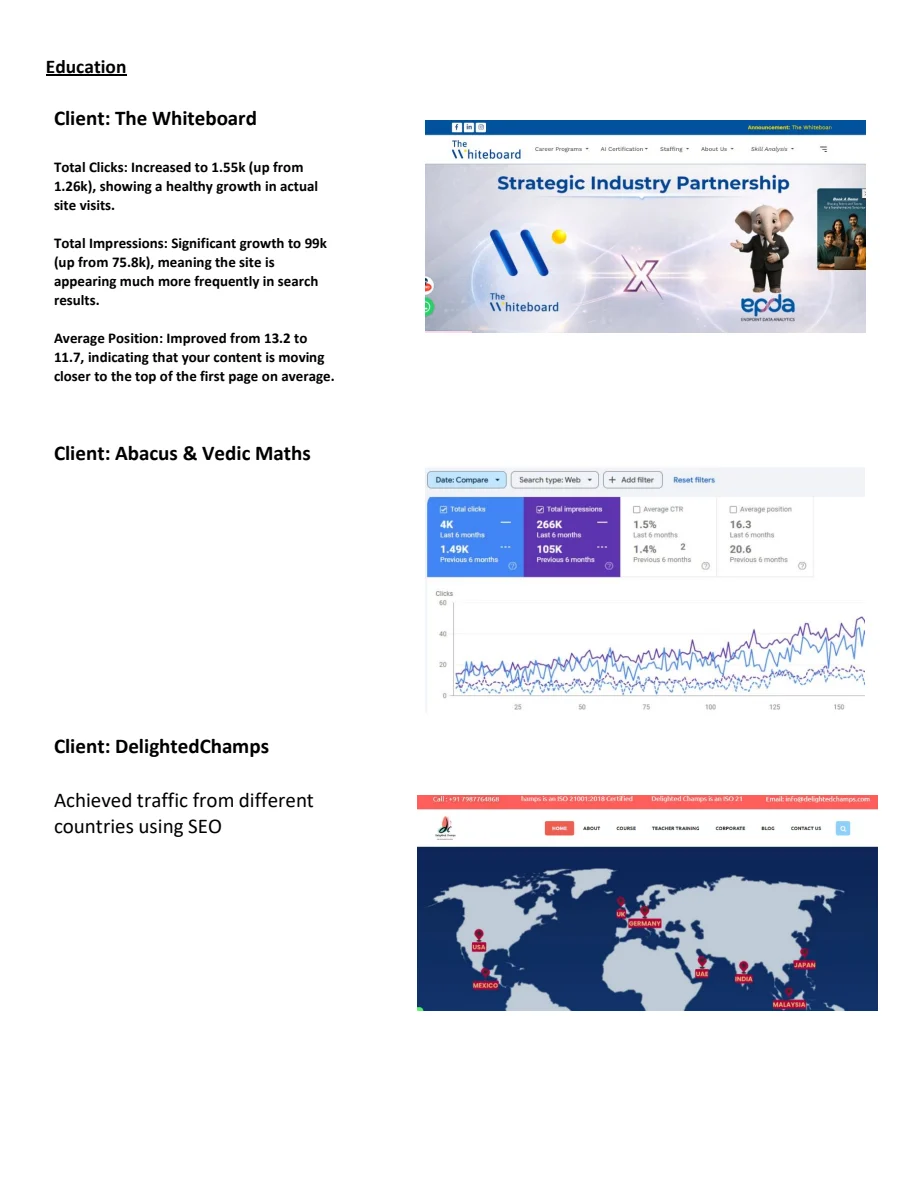
SEOsurfer’s education portfolio includes The Whiteboard, with historical Search Console reporting showing improvements in search clicks, impressions and average position.
Abacus & Vedic Maths
The portfolio includes Abacus & Vedic Maths, with a six-month Search Console comparison documenting growth in clicks and impressions.
DelightedChamps
DelightedChamps features in SEOsurfer’s education portfolio with a focus on international organic discovery.
DAACOnline.com
DAACOnline is part of SEOsurfer’s education client experience. Its website offers Physics and Maths coaching for Classes XI and XII, with online and hybrid learning information.
View the portfolio evidence
Client websites: DAACOnline ↗
02 / Built around the business
A plan that reflects how your customers decide.
Professional courses & training
Explain the curriculum, prerequisites, delivery method and genuine course outcomes so prospects can evaluate fit before enquiring.
EdTech & online learning
Connect searchable programme content with product demonstrations, learning experience and a clear trial or enquiry path.
School-age enrichment
Help parents understand what is taught, who teaches it and how classes work. Use accurate information and appropriate permissions for any child imagery.
Institutes with multiple programmes
Build an intelligible course hierarchy and a consistent process for updating batches, dates, availability and enquiry routing.
03 / What we connect
Education & EdTech SEO, paid media and conversion strategy.
Course & technical SEO
Organise programme pages, learning topics and internal links around distinct intent. Review crawlability, duplicated course content and mobile usability.
Paid learner acquisition
Connect campaigns to the programme, audience and upcoming intake. Review qualified enquiries with the admissions or course-advice team.
Programme landing pages
Make curriculum, eligibility, delivery, pricing conditions and next steps easy to understand. Support claims with genuine evidence and accurate institutional information.
Enquiry & enrolment measurement
Separate downloads, demo requests and course enquiries from qualified prospects and enrolments. Connect downstream stages where suitable records exist.
04 / The working approach
Start with the decision.
Follow through to the outcome.
-
Map programmes and learner needs
Identify the courses, age groups or professional audiences, delivery model and capacity for the coming intake.
-
Audit discovery and course clarity
Review search visibility, programme structure, duplication and the information learners need before they enquire.
-
Improve the route to a decision
Prioritise course pages, landing pages and campaign messages. Agree who maintains dates, eligibility and outcome claims.
-
Review progression with the team
Compare sources with qualified conversations, demos and recorded enrolments. Use feedback to improve targeting and course information.
Priorities, delivery sequence, responsibilities and costs are agreed after discovery. Advertising spend and tools are scoped separately.
05 / Make an informed choice
Looking for the best digital marketing or SEO consultant for education and EdTech businesses?
Compare relevant experience, the quality of the proposed work and how results will be measured. The right fit depends on your business, capacity and starting point.
Relevant proof
Ask what was delivered, when it happened and what the evidence actually measures. Check that historical results are labelled and that claims match the supporting records.
A useful implementation plan
Identify the courses, age groups or professional audiences, delivery model and capacity for the coming intake. Ask which changes come first and who owns each decision.
Clear account ownership
Agree on ownership of domains, advertising accounts, analytics and creative assets. Clarify access, reporting, fees and handover arrangements.
Honest measurement
Separate downloads, demo requests and course enquiries from qualified prospects and enrolments. Connect downstream stages where suitable records exist.
People behind the work
Strategy led by Narendra Kumar Pankaj.
Narendra leads SEOsurfer’s strategy across search, paid acquisition, analytics and digital growth. Established in 2012, SEOsurfer combines consulting and implementation with practical digital marketing training.
The client examples above describe documented or business-confirmed experience. New engagements begin with an assessment of your goals, website and measurement setup.
06 / Questions, answered
Education & EdTech digital marketing & SEO FAQs
Practical answers for education and EdTech businesses evaluating their next marketing investment.
01 What does digital marketing for education businesses include?
It can combine course SEO, paid campaigns, programme landing pages, useful learning content and enquiry tracking. The plan should match the audience and delivery model. A professional training provider, EdTech product and parent-led enrichment programme need different decision journeys.
02 How do I choose the best digital marketing consultant for education?
Look for relevant experience, clear thinking about learner fit and transparent reporting. Ask how the consultant will work with your course-advice team and distinguish enquiries from enrolments. Review the evidence behind any placement or admission-related marketing claim.
03 What should the best SEO consultant for EdTech demonstrate?
Ask for a technical audit approach, an intelligible programme structure and examples of useful course content. The consultant should explain how search intent differs between research, course comparison and enrolment. Ranking a broad topic is not the same as attracting suitable learners.
04 Which education clients are part of SEOsurfer’s experience?
The Whiteboard, Abacus & Vedic Maths, DelightedChamps and DAACOnline are included in SEOsurfer’s education portfolio. DAACOnline offers Physics and Maths coaching for Classes XI and XII.
05 What does The Whiteboard example show?
The portfolio reports higher search clicks and impressions and an improved average position, with clicks shown as 1.55k versus 1.26k. The comparison dates are not supplied. It is a historical search-performance example rather than a current ranking or enrolment report.
06 What does the Abacus & Vedic Maths example show?
The displayed Search Console comparison shows 4k clicks for the last six months and 1.49k for the previous six months, alongside 266k versus 105k impressions. The calendar dates are not visible. The figures measure search activity, not paying students.
07 Does every course need a separate page?
A distinct programme usually benefits from a page that explains its curriculum, audience, prerequisites and delivery. Avoid creating near-identical pages for minor keyword variations. Use a clear hierarchy when programmes share modules or have several related versions.
08 What should an education course page contain?
Include what is taught, who the course is for, prerequisites, delivery format, duration, relevant faculty information and the next step. State prices or fee conditions accurately when published. Keep dates and availability current and substantiate outcome claims.
09 Should we target students or parents?
Choose based on the real decision process. Parent-led programmes need clear teaching, schedule and suitability information, while professional courses may require curriculum depth and prerequisites. Campaign and enquiry design should reflect the audience rather than using one message for everyone.
10 How do you select education SEO keywords?
Map real programmes to research, comparison and enquiry intent. Consider subject, delivery method, location and learner needs, then assess demand and competition. Prioritise topics you can answer accurately and connect to a useful next step.
11 Can local SEO help a training institute?
An eligible business profile and a useful page for each real teaching location can help nearby prospects find classes and contact information. Make online and classroom delivery clear. Do not imply physical centres exist in locations served only online.
12 How should online programmes target multiple regions?
Explain actual delivery availability, time zones and support arrangements. Add regional information where it is genuinely useful. Avoid publishing large sets of location pages that repeat the same course copy without answering a different learner need.
13 Can Google Ads generate course enquiries?
Paid search can reach people researching relevant programmes when the landing page and follow-up process are ready. Review query quality and distinguish brochure downloads from qualified enquiries. Campaign success depends on programme fit and follow-up as well as targeting.
14 What role can Meta Ads play for education businesses?
Meta campaigns can introduce programmes, explain learning experiences and promote relevant events or demos. Use accurate creative and evaluate the resulting learner fit. Review applicable audience requirements and permissions, particularly when content involves children.
15 How should marketing change around a new batch?
Work backwards from actual start dates, available places and the time prospects need to decide. Update landing pages and campaign messages as availability changes. Avoid false countdowns or limited-seat claims that the institute cannot substantiate.
16 How can demo classes and webinars support acquisition?
A useful demo can help prospects evaluate teaching style and programme fit. Explain what the session covers, how to attend and what happens afterwards. Track registration and attendance separately, and assess how many attendees progress to a relevant course conversation.
17 How do you improve education lead quality?
Clarify prerequisites, delivery, audience and fees or fee conditions before asking for an enquiry. Agree with the course team on what makes a suitable lead. Review feedback to improve targeting instead of optimising only for cheaper form submissions.
18 Which education marketing metrics should we track?
Track relevant search activity, qualified course enquiries, demos, attendance and recorded enrolments. Separate free resource downloads from commercial intent. Use a consistent reporting window and reliable admissions records before attributing paid enrolments to a channel.
19 Can you connect enquiries with admissions software or a CRM?
Where tools and access allow it, source information can be connected to agreed stages such as contacted, qualified, demo attended and enrolled. Define the stages first and test the data flow. Do not assume every form submission is a valid or unique prospect.
20 How should testimonials and placement claims be presented?
Use genuine, permission-based feedback and clearly defined outcome evidence. Explain the population and period behind placement statistics where used. Avoid implying a guaranteed job or career result from a single learner’s story.
21 How can course websites demonstrate E-E-A-T?
Identify the institution and relevant teachers, publish accurate qualifications and explain how the programme is delivered. Show genuine teaching or learner evidence where permissions allow. Keep course facts current and distinguish educational outcomes from promotional aspirations.
22 Can education content appear in AI search?
Useful, accessible course information and clear business identity support ordinary search eligibility and AI discovery. Keep answers accurate, internally linked and available in HTML. No specific markup or consultant can guarantee that a platform will cite a page.
23 How long does education SEO take?
Results depend on competition, existing visibility, content quality and implementation. Set a baseline for programme pages and review meaningful progress over an agreed period. A rise in impressions alone does not demonstrate improved enrolment.
24 How much should an institute budget for marketing?
Base the budget on programmes, audience, intake timing, capacity and available assets. Separate professional fees, implementation, tools and advertising spend. Agree on the value of a qualified enquiry and the reporting needed before expanding campaigns.
25 What happens in the first education marketing consultation?
We review your programme mix, delivery model, upcoming batches, website and enquiry workflow. Bring available campaign and admissions reports. The next step is a scoped plan connecting content, acquisition and measurement responsibilities.
Let’s connect the next step
Help the right learners discover the right programme.
Tell us about your priorities and current marketing. We’ll start with the website, the customer journey and the outcomes you need to measure.